Events
Raindeer is an event-driven framework that represents the Request-Response lifecycle as events. It's easy to latch on to any event as they happen and perform additional tasks.
Note
Raindeer is event-driven internally but your application doesn't have to be. In fact, Raindeer's main events are abstracted away to such a degree that you can ignore them.
Request-Response Lifecycle
- RequestEvent - The server converts HTTP requests into request events
- RouteEvent - The router creates route events from request events
- RenderEvent - A node observes a route event and renders a response
- ResponseEvent - A response event is converted into an HTTP response and given to the requester
Observing Events
observe syntax
Observe the event with:
class MyNode < LowNode
  observe MyEvent

  def render
    "My Response"
  end
end
on syntax [UNRELEASED]
Better distinguish event handlers from regular methods in a class with:
on MyEvent do |my_event|
  # Do something.
end
Observe a particular action:
on MyEvent => :my_action do |my_event|
  # Do something.
end
Breakdown:
- Class level scope
- Returns a value
- Not for returning RBX (yet)
- More performant (needs benchmarking)
See also: Observers
Events Types
RequestEvent
The RequestEvent contains a request attribute, which is a Protocol::HTTP::Request provided by Protocol::HTTP. It is also responsible for keeping track of every subsequent event.
RouteEvent
Observe a route and it will trigger the render action/class method on a node/observer. The method factory pattern takes over; instantiating the node with a RenderEvent, before calling the instance render method with the same RenderEvent.
RenderEvent
Calls render instance method by defalult, after observing a route or rendering a node via Antlers in the template.
ResponseEvent
Attribute response is a Protocol::HTTP::Response
Advanced
Creating Events
Note
Creating events is completely optional.
Milestone events for the main flows are created for you and you can just listen to them. However you may want to create your own:
class MyEvent < LowEvent
  attr_reader :my_data

  def initialize(my_data:, action: :my_action)
    super(key: self.class, action:)

    @my_data = my_data
  end
end
Breakdown:
action:- The name of the method that you would like to call on the observerkey:- The actual value to observe, which can be the class itself likeMyEventor any value such as a String@my_data- Any data you want to store as an attribute or multiple attributes
Trigger the event's action on its observers with:
MyEvent.trigger(my_data: "Custom Data")
Architecture
Event-Command Hybrid
Raindeer events are different to traditional events in event-driven architectures; they represent something that is currently happening, not something that has already happened.
| Event | LowEvent | Command | |
|---|---|---|---|
| Tense | Past | Past/Present/Future | Future |
| Naming | OrderCreated | OrderEvent | CreateOrder |
| Action | 🚫 | :create_order |
✅ |
| Mutability | Immutable | Mutable/Immutable | Immutable |
| State | 🚫 | Ordered Actions | 🚫 |
| Broadcasting | One to many | Ordered one to many | One to one |
| Data flow | Pull | Push and pull | Push |
| Return value | 🚫 | Value or nil | Value |
Event Tree
Because events represent a period of time they will have sub-events, resulting in a tree-like structure of parent and child events:
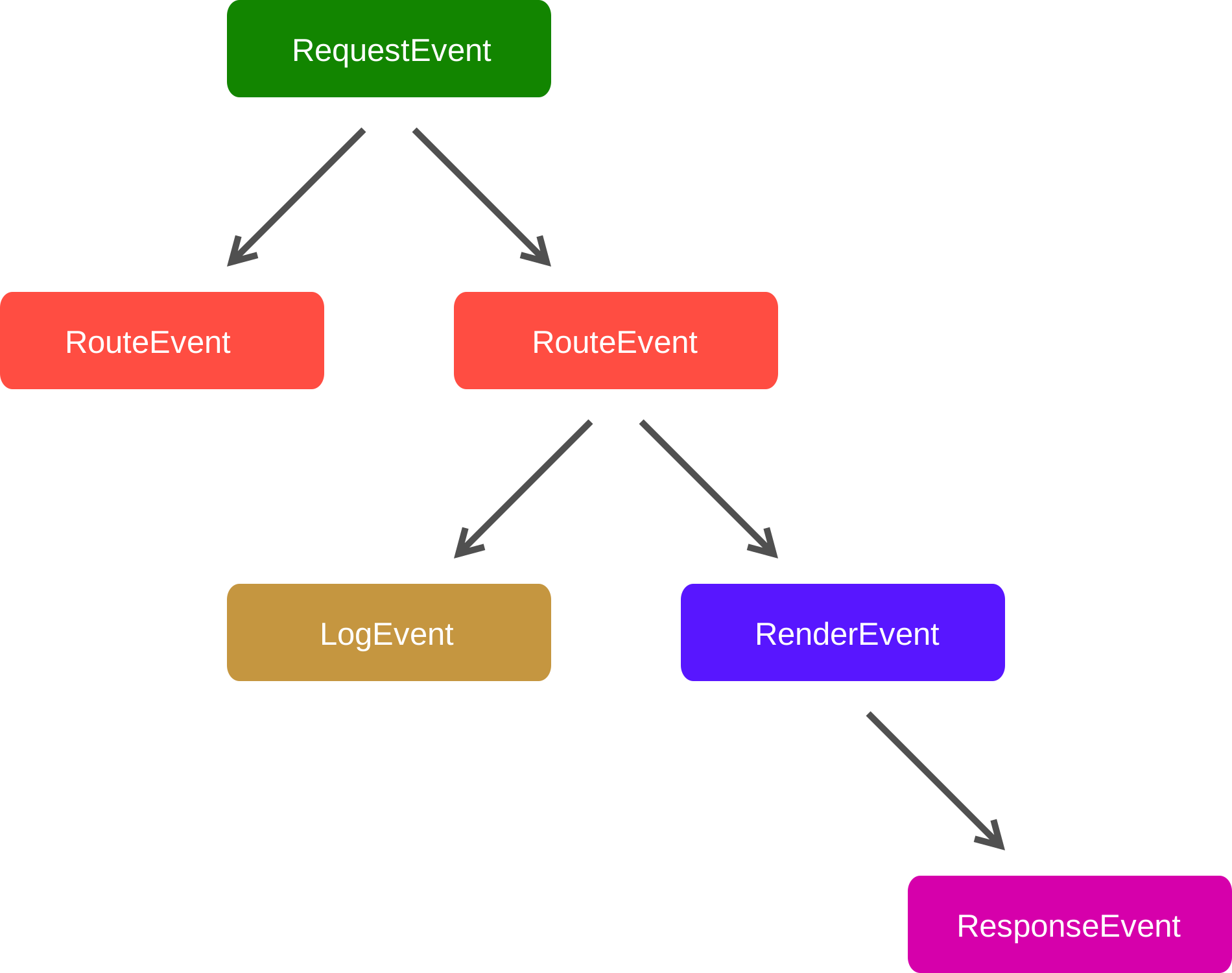
This structure can be used in debugging for enhanced observability. In the future this information will be shown in the /system UI, detailing who triggered and who responded to an event.
Problems VS Solutions
Event-driven and distributed systems can suffer from a "who did what" problem. Raindeer mitigates each of these pain points:
| Problem | Solution |
|---|---|
| Implicit/hidden wiring | Explicit observe/observers << |
| Unpredictible ordering | Ordered and one-directional flow |
| Unpredictible effects | trigger and take action types |
| Testing side effects | Observers must be added per test |
| Discoverability | System UI lists events/routes/observers |
| Debugging and Logging | Events are pipelines and tracked via UI |
Unit Testing
Events must be manually observed in the test if you want to trigger observers.